The Best Core Exercises for All Fitness Levels
Exercises such as bridges, crunches, and planks work different muscles in the core. Working these muscles can improve mobility, spinal and core stability, and make daily activity easier.
Whether you’re pushing a shopping cart or putting on shoes, you use your core to perform many daily activities. It also affects your balance, posture, and stability.
Contrary to popular belief, your core doesn’t just include your abdominal muscles. It also consists of muscles in your back and around your pelvis.
Your core, or core, includes:
- Erector spinae: The erector spinae is a group of three back muscles that run all the way to your trunk. It helps you stand up straight after bending over, as well as help you bend sideways and rotate your head.
- Rectus abdominis: When you bend forward, you use an abdominal muscle called the rectus abdominis. It’s sometimes called the “six-pack” muscle.
- Obliques: The internal oblique and external oblique help you rotate or bend your trunk.
- Transverse abdominis: The transverse abdominis, which wraps around the front and sides of your trunk, stabilizes your pelvis.
- Multifidus: The multifidus in your back supports your spine.
Other muscles that make up your core include:
- the pelvic floor
- the diaphragm
- the glutes
- the muscles that attach to your pelvis (hamstrings, hip flexors, and hip adductors)
- Keeping these muscles strong helps stabilize your body, support your spine, and improve overall fitness.
Read on to learn about the best core-strengthening exercises for every fitness level.
Beginner moves
If you’re just starting to exercise or haven’t worked out in a while, start with these beginner moves.
It may also be a good idea to consult with a personal trainer to talk about the right amount of reps and sets for your fitness level and personal goals.
Throughout these exercises, you’ll see the phrase “engage your core,” but how do you know if you’re actually doing it?
A good way to start is to inhale, and as you do, imagine that you’re drawing your belly button in toward your spine. Hold your muscles tight in that position for a few seconds.
This feeling of tight abdominal muscles is what it feels like to engage (or tighten) your core.
Bridge
This pose engages your glutes to lift your hips, which helps train your core and tone your glutes and thighs.
- Start on your back. Bend your knees and place your feet on the floor hip-width apart. Place your hands at your sides, palms down.
- Engage your core and glutes.
- Lift your hips until your knees are shoulder-width apart.
- Hold for 10 to 30 seconds.
- Repeat 3 to 5 times.
Crunch
Crunches are a classic core-strengthening exercise. The act of lifting your upper body works your abdominal muscles.
If you have occasional lower back pain, do crunches with caution: Do them slowly and start with just a few reps.
If you have chronic lower back pain, talk to a certified trainer or health care professional before trying this classic exercise. It may not be the best option for you.
- Start on your back. Bend your knees and place your feet on the floor hip-width apart. Align your head and spine. Cross your arms over your chest.
- Tighten your abdomen and relax your neck and shoulders. Tuck your chin in and lift your upper back, keeping your lower back, pelvis, and feet on the floor. Pause.
- Slowly lower your upper back to the starting position.
- Start with 1 set of 8 to 12 repetitions.
Supine Toe Tap
This is a basic Pilates exercise. It activates your core muscles while working your hips and legs.
- Toe touches also put minimal pressure on your spine. If you have back pain, toe touches can be an ideal alternative to crunches.
- Start on your back. Lift your legs up with your knees bent at 90 degrees. Place your hands at your sides, palms down.
- Contract your core. Lower your right foot and gently tap the floor, keeping your left leg still and your back flat.
- Raise your right leg to return to the starting position.
- Repeat the exercise with your left leg.
- Start with 1 set of 8 to 12 reps.
Bird Dog
The Bird Dog exercise activates your abdominal and back muscles, making it an ideal exercise for strengthening your core. It also challenges your coordination, balance, and stability.
- Start on all fours, with your hands under your shoulders and your knees under your hips.
- Engage your core. Lift and extend your right leg to hip height. At the same time, lift and extend your left arm to shoulder height, palm down. Keep your spine neutral without allowing your back to arch as you extend your arm and leg.
- Pause.
- Repeat the exercise with your left leg and right arm.
- Start with 1 set of 8 to 12 reps.
Bicycle Crunch
This variation of a regular crunch works your obliques, rectus abdominis, and hips.
Start with your back on the floor, with your left knee bent and drawn toward your chest. Keep your right leg straight and slightly lifted off the floor. Place your hands behind your neck or on the bottom of your head; be careful not to pull on your neck as you do this move.
- With your left knee bent and right leg straight, lift your right shoulder off the floor and move your right elbow toward your left knee.
- As you bring your right shoulder back toward the floor, extend your left leg as you bend your right knee and draw it toward your chest.
- As your right knee moves further inward, lift your left shoulder off the floor and move your left elbow toward your right knee.
- Start with 3 sets of 12 alternating reps.
Intermediate Moves
Plank
The plank is a full-body exercise that targets your core. It also strengthens your arms, shoulders, back, glutes, and legs.
- Start on all fours, with your hands under your shoulders and your knees under your hips.
- Stretch your legs out behind you, keeping your feet hip-width apart. Brace your core.
- Hold for 10 to 30 seconds.
- Repeat 3 to 5 times.
- To make this exercise easier, keep your knees on the floor, with your weight on your hands. Keep a straight line from your knees to your shoulders.
Warrior crunch
This crunch variation works your core and lower body, including your thighs, glutes, and quads.
- Stand with your feet slightly wider than shoulder-width apart and toes facing out. Place your hands behind your head and open your chest.
- Brace your core and glutes. Bend your knees until your thighs are parallel to the floor.
- Bend your torso to one side, moving your right elbow toward your right thigh. Repeat on your left side.
- Start with 1 set of 8 to 12 reps.
Bird dog with elbow to knee
This variation of the basic bird dog incorporates a fluid movement to work your abs and back while improving core strength.
- Start on all fours, with your hands under your shoulders and your knees under your hips.
- Engage your core. Lift and extend your right leg to hip height. At the same time, lift and extend your left arm to shoulder height, palm down.
- Bring your right knee and left elbow together. Return to the starting position.
- Start with 1 set of 8 to 12 reps.
- Repeat on the other side.
Advanced moves
Once you’ve mastered the intermediate moves, challenge yourself with an advanced core routine. These exercises will further strengthen your core by engaging the muscles in more complex ways.
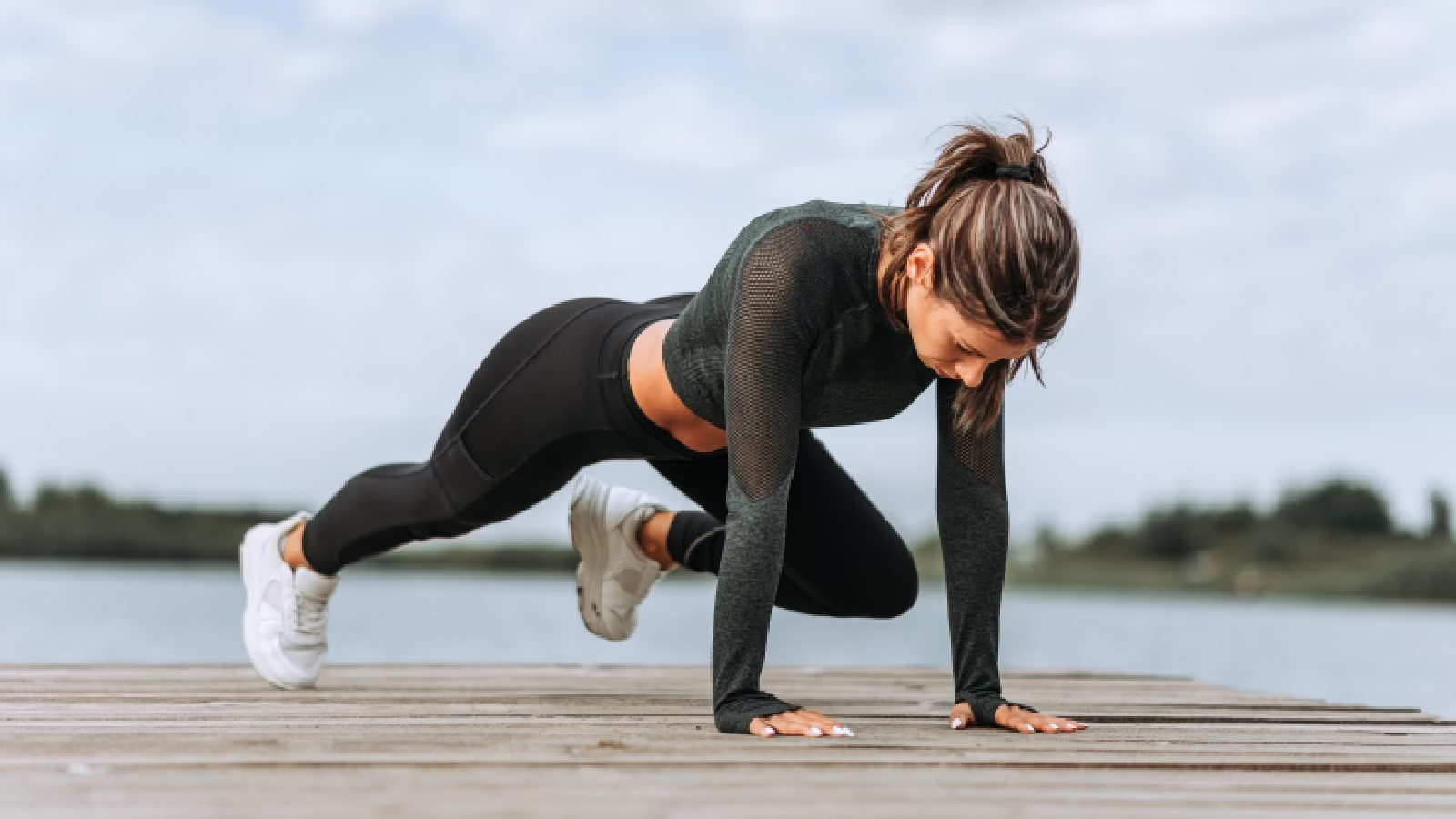
Mountain climber
This intermediate exercise combines the plank position with knee movements, making it great for balance and core strength.
- Start in a plank position with your hands under your shoulders. Engage your core.
- Lift your right knee toward your chest, keeping your back straight and your hips down.
- Return your right leg to the starting position while simultaneously lifting your left knee toward your chest.
- Continue alternating legs. Start with 1 set of 8 to 12 reps.
Side plank with rotation
This exercise is an advanced version of the basic plank. Combining a side plank with arm movements strengthens your arms, shoulders, and obliques.
- Lie on your right side with your right forearm under your shoulder. Extend your legs, with your left foot on top of your right. Tighten your abs.
- Lift your hips to form a straight line with your body. Lift your left arm up.
- Rotate your torso toward the floor and place your left arm under your body.
- Rotate your torso again to straighten your left arm and return to the starting position.
- Start with 1 set of 8 to 12 reps.
- Repeat on the other side.
Turkish get-up
This full-body move is a great way to increase spinal stabilization, as well as improve mobility in the hips, lumbar spine, and thoracic spine. It’s also great for increasing the strength of the abdominal muscles around the spine, as well as the shoulders.
Try this move once or twice without weights, and then start with something light (think 5 pounds) to make sure your shoulders are stable enough to support the weight overhead. Use a heavier weight as you gain strength.
- Lie on your back with your legs straight and your arms at your sides at about a 45-degree angle.
- Bend your right leg and place your right foot on the floor a few inches from your butt.
- Reach your right arm up toward the ceiling, forming a fist with your right hand and keeping your knuckles pointed toward the ceiling (this helps with shoulder stabilization).
- Focus your gaze on your fist—that’s where the weight will ultimately be. You should keep your fist directly over your shoulder throughout the movement.
- Next, push through your right heel and left elbow to prop yourself up on your left elbow, making sure your chest is facing forward, not up toward the sky.
- Next, push your left palm into the floor and pull your body up into a sitting position, allowing your abs to do most of the work.
- Next, slide your left leg underneath you, making sure your left knee and left ankle are in line with your left hand.
- Get on your knees with your left knee and right foot on the floor, lifting your left hand off the floor as you do so.
- While still holding your right arm above your head, press your right foot into the floor and bring your left leg forward, as if you were doing a lunge. You should now be standing!
- Now, do the movements in reverse until your back is back on the floor.
- Start with 3 to 5 reps.